Nogai music is neither a genre nor a folkloric niche. It is a mechanism for preserving the historical memory of a people whose cultural continuity faced the threat of rupture in the 20th century. Amidst repressions against the tradition’s keepers — bakhsy, storytellers, performers of the "Edige" epic, dombra players, and kobyz masters — music became the last resilient channel for transmitting the cultural code.
The Instrument as a Vessel of Meaning
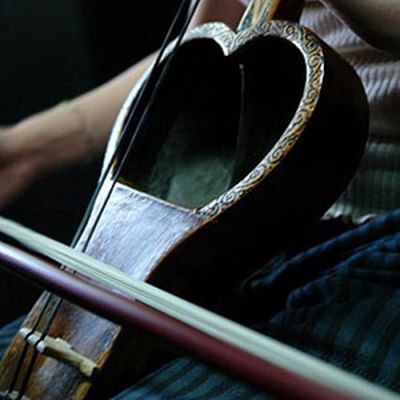
At the heart of this system lies the kyl-kobyz — an ancient two-stringed bowed instrument with an open body covered in leather. In Nogai and broader Turkic traditions, it is perceived not as a mundane tool, but as a mediator between worlds. If the dombra is the "soul" of the people, the kobyz is its "spirit."
The sacred status of the instrument defined its sphere of use: the kobyz was the prerogative of the bakhsy and epic bards, used in rituals of purification and healing, its sound intertwined with the spirits of ancestors. Horsehair strings and a unique sound extraction technique created an overtonal, "cosmic" resonance that affected not only the hearing but the subconscious. People often feared touching or even being in the same room as this instrument.
The loss of the kobyz signified more than the disappearance of an instrument; it was the destruction of an entire institution of spiritual mentorship. During the Soviet period, these instruments were seized and destroyed as cult objects, and the continuity of the tradition was severed for decades.
Poetry as a Historical Archive
Equally vital is the musical interpretation of classical 15th–17th-century poetry. The texts of the "zhyrau," bound to historical events and collective memory, find new life through modern sound. This elevates medieval works from academic archives into the realm of living culture.
In this context, music functions as a mediator of time: it makes historical experience emotionally accessible, ensuring the intergenerational transfer of meaning. The historical trauma captured in poetry becomes a part of modern cultural consciousness rather than a forgotten episode of the past.
Consolidation Through Sound
Nogai music performs another strategic function — consolidation. For a people dispersed across various regions and countries, shared melodies and symbolic works become a form of cultural unity. Songs that have entered the modern canon create a common musical language that sustains identity regardless of geography.
Thus, Nogai music serves not only as an artistic practice but as a system for safeguarding historical memory. Through traditional instruments, sacred rites, zhyrau poetry, and concert performances, it holds the cultural code, providing continuity where tradition was once broken.
Music becomes a space where the past continues to resonate in the present.
The Instrument as a Vessel of Meaning
At the heart of this system lies the kyl-kobyz — an ancient two-stringed bowed instrument with an open body covered in leather. In Nogai and broader Turkic traditions, it is perceived not as a mundane tool, but as a mediator between worlds. If the dombra is the "soul" of the people, the kobyz is its "spirit."
The sacred status of the instrument defined its sphere of use: the kobyz was the prerogative of the bakhsy and epic bards, used in rituals of purification and healing, its sound intertwined with the spirits of ancestors. Horsehair strings and a unique sound extraction technique created an overtonal, "cosmic" resonance that affected not only the hearing but the subconscious. People often feared touching or even being in the same room as this instrument.
The loss of the kobyz signified more than the disappearance of an instrument; it was the destruction of an entire institution of spiritual mentorship. During the Soviet period, these instruments were seized and destroyed as cult objects, and the continuity of the tradition was severed for decades.
Poetry as a Historical Archive
Equally vital is the musical interpretation of classical 15th–17th-century poetry. The texts of the "zhyrau," bound to historical events and collective memory, find new life through modern sound. This elevates medieval works from academic archives into the realm of living culture.
In this context, music functions as a mediator of time: it makes historical experience emotionally accessible, ensuring the intergenerational transfer of meaning. The historical trauma captured in poetry becomes a part of modern cultural consciousness rather than a forgotten episode of the past.
Consolidation Through Sound
Nogai music performs another strategic function — consolidation. For a people dispersed across various regions and countries, shared melodies and symbolic works become a form of cultural unity. Songs that have entered the modern canon create a common musical language that sustains identity regardless of geography.
Thus, Nogai music serves not only as an artistic practice but as a system for safeguarding historical memory. Through traditional instruments, sacred rites, zhyrau poetry, and concert performances, it holds the cultural code, providing continuity where tradition was once broken.
Music becomes a space where the past continues to resonate in the present.